
As an interior designer specializing in US home transformations for over 15 years, I’ve witnessed the remarkable power of statement mirrors to completely revolutionize living spaces. In my work with clients across New York lofts, Chicago bungalows, and California ranch homes, I’ve discovered that mirrors aren’t just functional accessories—they’re design powerhouses capable of creating drama, enhancing light, and adding perceived square footage without breaking the bank. Research shows strategically placed mirrors can amplify perceived space by up to 30% while boosting natural light by 80%, making them essential tools for American homeowners where square footage costs an average of $250/sq ft.
Unlike traditional artwork, mirrors actively interact with your space rather than simply occupying it. They transform ordinary rooms into extraordinary experiences by playing with light, perspective, and dimension. Whether you’re working with a cramped NYC studio or a spacious suburban family room, the right mirror placement can solve practical problems while elevating your aesthetic. Let me share with you 15 proven techniques I’ve used to create stunning focal points and dramatic transformations in living rooms across America.
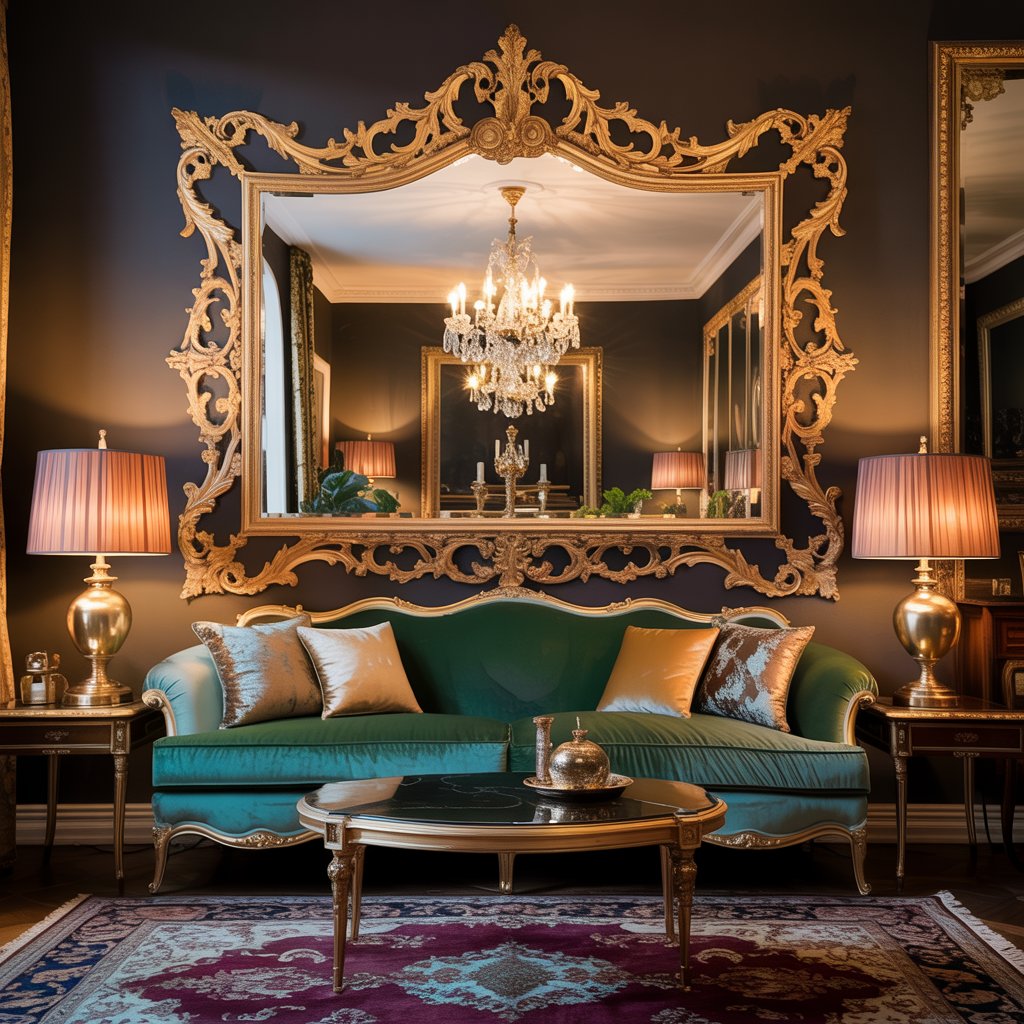
Why Statement Mirrors Are Interior Design Superheroes
Beyond merely reflecting your appearance, mirrors serve as dynamic design elements that manipulate how we perceive space and light. When I consult with homeowners feeling frustrated by dark, cramped living areas, I often suggest mirror solutions before recommending expensive renovations. The psychological impact of mirrors is profound: they trick the eye into seeing “more room” while actually making existing space feel more intentional and thoughtfully designed.
My approach always considers both function and form—mirrors should solve a problem while becoming a conversation piece. For rental properties where walls can’t be altered, mirrors offer a dramatic upgrade without permanent changes. The key is strategic placement that complements your existing architecture and natural light patterns. As designer Kelly Wearstler famously said, “A well-placed mirror isn’t just decoration—it’s architecture you can hold in your hand.”
Key Benefits of Using Statement Mirrors (Click to Expand)
- Space Amplification: Creates visual depth in compact living areas
- Light Multiplication: Reflects natural and artificial light throughout the room
- Architectural Interest: Adds dimension where walls feel flat or uninteresting
- Flexibility: Easily changed or rearranged as decor evolves
- Cost-Effective: Delivers high impact for relatively low investment
Floor-to-Ceiling Mirrors: Creating Illusionary Space

When clients feel trapped in small living rooms, my go-to solution is often a floor-to-ceiling mirror with subtle grid detailing. This isn’t about creating a dance studio aesthetic but rather crafting a sophisticated optical illusion that makes 800 square feet feel like 1,100. I particularly love recommending this for New York City apartments where every inch counts. Position the mirror opposite your main seating area to reflect the most desirable part of your room, not the TV or doorway.
The geometric grid pattern prevents the mirror from feeling like a cold, clinical surface while maintaining the expansive effect. Opt for a frame in a warm metallic finish like oil-rubbed bronze or brushed brass to anchor the mirror in your color scheme. In my recent Boston brownstone project, this technique transformed a boxy 12’x14′ space into what my clients now call their “magically spacious” living area.
Pro Tip: For rental-friendly installations, consider removable adhesive mirror panels instead of permanent installations. Companies like [Artera Home] offer woven mirror panels that peel and stick without damaging walls—perfect for urban dwellers in cities like Chicago and Seattle where landlord restrictions are common.
Mantel Statement Mirrors: Elevating Your Fireplace
Your fireplace mantel deserves a companion that complements its architectural significance, and nothing delivers like a well-chosen statement mirror. Forget the tired tradition of generic rectangular mirrors—instead, select a piece with character that reflects your personal style. I often recommend distressed vintage mirrors with ornate detailing for traditional homes, while minimalist floating frameless designs work beautifully in modern spaces.
Measure carefully: your mirror should span 60-70% of the mantel width and extend no more than 6-8 inches above it. In my suburban Philadelphia project, a 48″ x 36″ sunburst mirror above the mantel became the instant focal point, reflecting both the cozy seating area and the garden view through adjacent French doors. This dual reflection creates what my clients call “visual storytelling”—each glance reveals new details.
Oversized Round Mirrors: Adding Soft Drama
While squares and rectangles dominate our architectural landscape, the circle remains design’s most powerful shape for creating organic flow. An oversized round mirror (40″ diameter minimum) positioned above your sofa creates a soft focal point that guides the eye without harsh angles. This technique works especially well in open-concept layouts where you need to define the living area without physical barriers.
Consider the frame: a wide, substantial frame makes a stronger statement than thin borders. I frequently pair these with mid-century modern furniture to create intentional contrast—clean lines meeting circular softness. For dramatic effect, position your round mirror on a wall with interesting architectural features like wainscoting or exposed brick; the curved reflection will soften those angular elements beautifully.
Sunburst Mirrors: Making Bold Architectural Statements
When you need to make an undeniable design impact, nothing competes with a sunburst mirror’s dramatic silhouette. These statement pieces—popularized in the 1970s but enjoying a sophisticated resurgence—create instant focal points that command attention. Choose one with irregular, organic rays for contemporary spaces, or opt for a symmetrical gold-toned piece for traditional elegance.
Placement is crucial: sunbursts work best on walls with minimal competing elements. In my recent Miami beach house project, a 36″ sunburst mirror opposite large sliding doors reflected both the ocean view and the room’s central seating area, creating what my clients described as “a portal to paradise.” Avoid placing too high; the mirror’s center should hit at standard eye level (57-60 inches from floor).
Pro Tip: In rooms with high ceilings (9+ feet), position sunburst mirrors on vertical accent walls to draw the eye upward and emphasize height rather than width.
Gallery Wall of Mirrors: Creating Visual Rhythm
Transform blank expanses into dynamic art installations using multiple mirrors of varying shapes and sizes. Group three to five mirrors in complementary frames—try a sunburst mixed with a vintage oval and rectangular piece—to build visual rhythm without overwhelming the space. This approach works especially well in narrow hallways or above staircases where monolithic artwork would feel oppressive.
The magic happens in the arrangement: lay mirrors on the floor first, photograph the layout, and use painter’s tape to mark positions. Start with your largest piece as the anchor, then build outward with smaller frames, keeping consistent spacing (3-5 inches between edges). For cohesive flair, mix frame finishes thoughtfully—say, brass with black metal—but avoid more than three distinct finishes.
Mirrored Coffee Tables: Adding Unexpected Glamour
Move over, basic wooden coffee tables—today’s sophisticated spaces deserve furniture with reflective personality. A mirrored coffee table serves dual purposes: it functions as a surface while multiplying the visual impact of everything around it. In my work with dark-hued living rooms, this single element has transformed spaces from cave-like to luminous.
Select a table with beveled edges for added dimension and consider size carefully—oversized mirrored tables can feel overwhelming in small spaces. I prefer pairing these with textured fabrics (like velvet or woven throws) to balance the reflective surface. For a showstopper effect, place a floral arrangement or sculptural object on the table; the reflection creates what I call “double decor”—one physical piece becoming two visual elements.
Floating Mirrors Above Consoles: Creating Breathing Room
Elevate entryways or living rooms by mounting a large horizontal mirror 6-8 inches above a console table. The gap between creates breathing room while doubling the visual impact of both pieces. For maximum effect, choose a mirror width that spans 80% of your console table’s length.
This technique shines in narrow spaces that need lengthening. I’ve used it repeatedly in New England colonial homes with long, skinny entryways that previously felt like afterthoughts. The reflection of the table and its accessories creates an illusion of depth, while the vertical space between mirror and furniture adds sophistication. Pair with a statement table lamp on the console—it will appear doubled in the mirror for dramatic lighting effects.
Architectural Mirror Shapes: Beyond Basic Geometry
Move past the predictable rectangles and explore organic shapes that complement your home’s architectural character. Hexagonal, octagonal, and irregular freeform mirrors create conversation-starting focal points that transcend basic decor. In modern farmhouse settings, I often recommend oversized arched mirrors that nod to traditional architecture while feeling refreshingly contemporary.
The key is matching shape to architectural context: angular mirrors complement contemporary spaces with clean lines, while curved forms soften rooms with traditional moldings. My recent project in a Dallas loft featured a trio of trapezoidal mirrors arranged asymmetrically above the sofa—each reflecting a different aspect of the room, creating what my client called “living art” that changes with the light.
Mirrored Accent Walls: Transforming Entire Surfaces
For the bold at heart, consider transforming an entire wall into a reflective surface using multiple mirror panels. This isn’t the dated disco-ball aesthetic of the 1980s but a sophisticated, intentional design choice that creates stunning spatial illusions. Use beveled-edge mirrors in a grid pattern for traditional spaces or seamless large-format panels for contemporary minimalism.
In compact city apartments, I often recommend this technique for the wall opposite windows to maximize light penetration. A recent 450-square-foot Manhattan studio felt nearly twice as large with mirrored panels covering the narrowest wall. The key is strategic placement—never cover all four walls, as this creates disorientation rather than expansion.
Mirrors Opposite Windows: Maximizing Natural Light
The single most effective technique for making a room feel larger is placing a mirror directly across from a window. This strategic positioning captures natural daylight and bounces it deeper into the space, effectively doubling your light source without additional fixtures. As noted by experts at [Artera Home], when properly aligned, the mirror creates “the psychological impression of a second window.”
For optimal effect, position the mirror at the same height as the window and ensure it reflects the outdoor view—whether sky, greenery, or interesting architecture. In my Seattle projects where natural light is limited, this technique has transformed dark spaces into sun-drenched sanctuaries. The magic happens when your brain interprets the reflected view as additional space, creating what I call “light layering” that enhances depth perception.
Mirrors in Unexpected Places: Stairwells and Awkward Corners
Don’t limit mirror placement to traditional living room walls—creative positioning in overlooked areas can yield dramatic results. Stairwells, especially those with tight turns, benefit from long, narrow mirrors that enhance safety while creating visual continuity. Install a floor-length mirror on the landing wall to make ascending feel less oppressive and add perceived width to narrow staircases.
Awkward corners that seem impossible to decorate become opportunities with carefully chosen mirrors. Angle-cut mirrors fit perfectly into 90-degree corners, creating an illusion of additional space. In my Chicago projects with quirky architectural features, these unexpected placements have transformed dead zones into design highlights that draw the eye upward and outward.
Layered Mirror Installations: Depth Within Depth
Take mirror drama to the next dimension by layering multiple reflective surfaces. The most sophisticated installations I’ve created feature a large primary mirror with smaller companion mirrors floating at varying distances from the wall. This technique, borrowed from gallery display strategies, creates actual physical depth that plays with light in constantly changing ways.
For living rooms, try mounting a large rectangular mirror, then positioning smaller circular or oval mirrors in front of it using decorative brackets. The overlapping reflections create what I call “light fractals”—multiple points of interest that evolve throughout the day as sunlight shifts. This works particularly well in rooms with architectural niches or alcoves that need visual enhancement.
Mirrors with Dramatic Frames: Art as Functional Decor
The frame is your mirror’s first impression—make it count. A dramatic frame transforms functional decor into genuine art, creating instant focal points that anchor your design scheme. I often recommend substantial frames (3-4 inches wide minimum) in materials that complement your existing metals: brass for warm palettes, nickel for cool tones, or mixed materials for eclectic spaces.
Vintage frames add irreplaceable character; hunt for quality pieces at architectural salvage yards. For a designer hack, remove the mirror from an ornate vintage frame and replace it with a custom-cut beveled edge mirror for added dimension. As I tell my clients: “Your mirror frame should look intentional even when empty—a true work of art in its own right.”
Mirrored Room Dividers: Creating Zones with Reflection
In open-concept layouts where distinct zones are needed without physical barriers, mirrored room dividers offer the perfect solution. These aren’t the flimsy folding screens of the past but substantial architectural elements that define space while maintaining visual connectivity. Floor-to-ceiling mirrored panels on decorative bases create subtle separation without sacrificing light flow.
For urban apartments, I recommend dividers positioned at 45-degree angles to maximize reflection and minimize the “barrier” effect. The magic happens when the divider reflects complementary areas of the room, creating continuity between zones. In my Brooklyn loft project, a three-panel mirrored divider separated the living and dining areas while making both spaces feel more expansive—what I call “boundary without boundaries.”
Statement Mirrors with Integrated Lighting: Glowing Focal Points
Transform your statement mirror from passive reflection to active illumination with integrated lighting. Backlit mirrors featuring LED systems around the perimeter create dramatic halo effects that enhance both the mirror itself and the surrounding space. This technique works especially well in media rooms where soft ambient lighting complements screen viewing.
For traditional living rooms, consider vintage-inspired mirrors with integrated sconces on either side. I often source these from specialty lighting showrooms or customize existing mirrors with discreet lighting systems. The dual function provides both practical illumination and creates what I call “living reflections”—dynamic interplay between light sources that changes with the time of day and season.
Mirror Placement Cheat Sheet: Maximizing Impact
Optimal Mirror Sizing by Wall Dimensions (Click to Expand)
| Wall Height | Wall Width | Recommended Mirror Size | Placement Height (Center) |
|---|---|---|---|
| 8 feet | 10-12 feet | 30″ x 40″ | 57-60 inches |
| 9 feet | 12-15 feet | 36″ x 48″ | 60-63 inches |
| 10+ feet | 15+ feet | 48″ x 60″+ | 63-66 inches |
| 8 feet | 6-8 feet (narrow walls) | Vertical 40″ x 30″ | 57-60 inches |
Source: Interior Design Institute of America, 2025 Guidelines
Pro Tips from the Designer’s Toolkit
- Avoid the “Bathroom Mirror” Effect: Never create mirror placements that force constant self-reflection—position mirrors to reflect desirable elements of your space, not where you’ll see yourself constantly.
- Consider Your Ceiling Height: In rooms with 9+ foot ceilings, extend mirror height to 70-80% of wall height to maintain proportional balance.
- Reflection Quality Matters: Invest in high-quality mirrors with minimal distortion—cheap mirrors create wavy, disorienting reflections that undermine the spatial expansion effect.
- Seasonal Adjustments: In regions with dramatic seasonal light changes (like the Pacific Northwest), position mirrors to capture low winter sunlight specifically.
- Furniture Placement Synergy: Always position major seating to face the mirror’s reflection point for maximum impact when people are actually using the living room.
The Final Reflection
As I’ve guided clients through countless living room transformations, I’ve witnessed how statement mirrors can deliver immediate, dramatic results without the disruption of major renovations. Whether you’re working with a cramped New York apartment or a spacious suburban home, these reflective wonders offer flexible solutions that evolve with your changing needs and tastes.
Remember that the perfect mirror placement tells a visual story about your space, your lifestyle, and your aesthetic sensibilities. As I tell every client beginning their mirror journey: “Great mirror placement isn’t about seeing yourself—it’s about seeing your space in entirely new ways.” Start with one statement mirror placement from this guide, observe how it transforms your living experience, then build from there. Your most dramatic living room transformation might be just one reflective surface away.