
The Hallway You Didn’t Know You Needed
A dark, narrow hallway can feel like a tunnel — but one well-placed full-length mirror can instantly brighten the space and make it feel twice as wide. It’s the kind of quick, affordable transformation that feels almost unfair: you hang a single reflective surface, and suddenly your entryway stops being a place you rush through and starts being a place you actually notice.
Hallways are the unsung workhorses of the American home. They connect the front door to the living room, bedrooms to bathrooms, and kitchen to garage. They carry grocery bags, soccer cleats, sleepy teenagers, and muddy dogs — yet somehow we decorate them last, if at all. In most US homes built between the 1950s and early 2000s, hallways tend to share three frustrating traits: they’re narrow, they’re dim, and they feel disconnected from the rest of the home’s design story.
That’s exactly why a full-length mirror for hallway use is one of the smartest pieces of decor you can invest in. It does triple duty — bouncing natural light, creating an illusion of depth, and giving you a reliable place for a quick outfit check before you walk out the door. In this guide, we’ll walk through the styling tips that actually work in real homes: where to hang it, which frame to pick, how to pair it with lighting, and the small mistakes that make even an expensive mirror look underwhelming. Grab a tape measure — let’s get into it.
Why Full-Length Mirrors Work So Well in Hallways
Before we pick out frames and finishes, it’s worth understanding why a mirror performs so well in a hallway specifically — because once you understand the mechanics, you’ll make better placement choices.
The Visual Effects
Mirrors don’t just reflect what’s in front of them; they double the perceived volume of a room. Interior designers often describe this as “borrowed space” — the mirror creates a visual copy of the wall opposite it, tricking the eye into reading the room as wider or deeper than it is. In a 3-foot-wide hallway, a tall mirror placed along the long wall can make the corridor feel closer to five or six feet wide, simply because your eye registers the reflection as additional floor area.
Light reflection is the second superpower. Most US hallways have little or no direct natural light, often relying on a single ceiling fixture. A mirror positioned to catch light from a nearby window, doorway, or sconce will redistribute that light down the corridor, reducing the “tunnel” feeling almost immediately.
The Functional Benefits
Beyond the visual trickery, there’s a practical reason hallways and entryway decor go hand in hand. A mirror near the front door becomes a last-stop checkpoint — tie straightened, hair checked, keys grabbed. It also anchors the entryway visually, giving visitors a clear focal point the moment they step inside rather than staring down an empty corridor.
Common Hallway Challenges
Three hallway types show up again and again in US homes:
- The galley hallway (long, narrow, no windows) — common in split-levels and ranch homes
- The foyer-with-corridor (open entry tapering into a tight hall) — common in newer builds
- The upper landing hallway (short, often with a window) — common in two-story colonials
Each benefits from mirrors, but in slightly different ways — which is where placement and style choices really matter.
Choosing the Right Full-Length Mirror
The right mirror depends on three variables: size, style, and shape. Get any one of them dramatically wrong and even a beautiful piece can feel awkward.
Size and Scale
A reliable rule of thumb: a true full-length mirror should be at least 48 inches tall to reflect a full adult figure comfortably, and 60 to 72 inches is the sweet spot for most ceilings. Width should generally be between one-half and two-thirds the width of the wall it hangs on — anything much wider starts to overwhelm, anything much narrower reads as a decorative accent rather than a functional mirror.
📐 Quick mirror size guide by hallway type
| Hallway type | Recommended mirror size | Orientation |
|---|---|---|
| Narrow galley (under 4 ft wide) | 20–28 in wide × 60–70 in tall | Vertical, wall-mounted |
| Standard corridor (4–5 ft wide) | 28–36 in wide × 65–72 in tall | Vertical, leaning or mounted |
| Wide foyer hallway (5+ ft) | 36–48 in wide × 70+ in tall | Oversized mirror or paired panels |
For ceilings under 8 feet, leave at least 4–6 inches of breathing room above the mirror to avoid a “stuffed” look. For taller ceilings, an oversized mirror (think 78–84 inches) becomes a dramatic architectural statement.
Frame Styles and Finishes
Mirror frame styles are where your hallway’s personality really shows. For a clean, modern hallway styling approach, slim black metal or brushed brass frames feel current without dominating. Warm wood frames — oak, walnut, or whitewashed pine — anchor the space and pair well with Scandi, mid-century, or transitional interiors. Ornate vintage frames (gilded, distressed, or carved) work beautifully in traditional or eclectic homes, but need enough surrounding wall space to avoid a cluttered look. Beveled edges on frameless mirrors add a refined, almost architectural touch and are a great mirror trends 2026 choice for minimalist homes.
Mirror Shapes
Not every hallway mirror needs to be a strict rectangle:
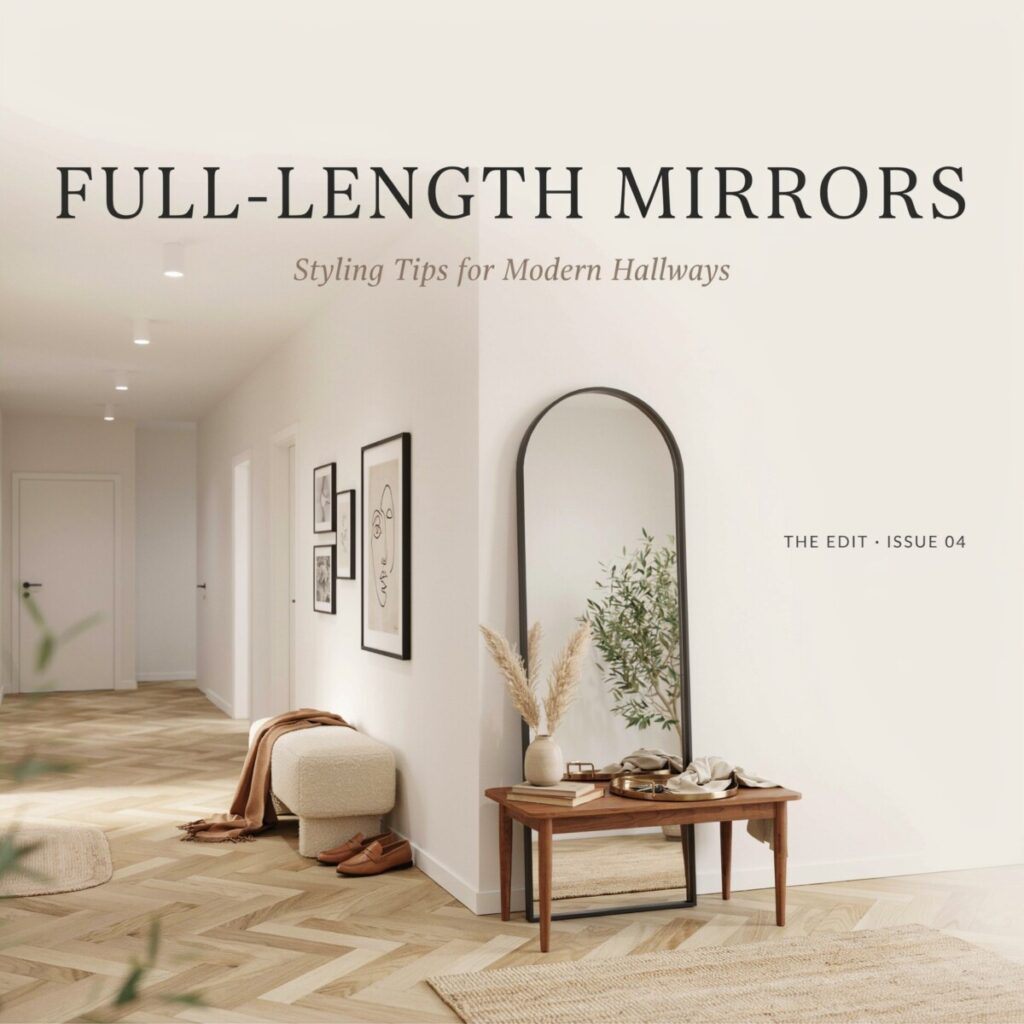
- Arched mirrors soften hard lines and pair well with warm modern or Mediterranean styles
- Rounded-corner rectangles feel current and safe for homes with small children
- Floor/leaner mirrors lean casually against the wall and suit relaxed, lived-in entryways
- Paired vertical panels create rhythm on long walls without needing one massive piece
Materials and Practicalities
In high-traffic hallways, choose safety-backed mirrors (the reflective layer is adhesive-bonded to a shatter-retaining film). For leaning mirrors, a weighted base or integrated anti-tip hardware is non-negotiable, especially in homes with kids or pets. If your hallway connects to a bathroom or laundry room — think Florida or Gulf Coast homes — look for moisture-resistant backing to prevent silvering deterioration over time.
Placement and Installation Tips
A beautiful mirror in the wrong spot is just a beautiful mistake. Here’s how to get the location and installation right.
Wall-Mounted vs. Leaning
Wall-mounted mirrors are the safer, cleaner choice for narrow hallways — they sit flush, don’t eat floor space, and are more stable. Leaner mirrors bring a relaxed, editorial feel and are renter-friendly (no heavy drilling), but they require floor space and must be secured.
For wall-mounted pieces, the bottom edge of the mirror should sit between 2 and 4 inches above the floor for a true full-length effect, or higher (about 9–12 inches) if there’s a baseboard heater, console, or shoe storage below it.
🔧 Safe mounting checklist
- Locate wall studs wherever possible — drywall anchors alone are risky for mirrors over 30 lbs
- Use a French cleat or heavy-duty D-ring hardware rated for 1.5× the mirror’s weight
- For rental apartments, consider removable heavy-duty picture-hanging strips for smaller (under 15 lb) accent mirrors only
- Always check the CPSC guidelines on wall-mounted furniture and decor for anchoring best practices
Best Wall Choices
The highest-impact placement is opposite a window or glass door, where the mirror reflects both natural light and an outdoor view into the hallway. The second-best spot is along the longest uninterrupted wall, where it reads as an architectural element rather than an afterthought. Mirrors also work beautifully adjacent to coat racks, entry consoles, or at the far end of a hallway to visually “extend” the space — a classic narrow hallway solution used by designers for decades.
If your hallway has interesting architecture — crown molding, wainscoting, a vintage newel post — angle the mirror to reflect those details. It quietly draws attention to the home’s best features.
Tricks for Narrow Hallways
For tight corridors, avoid one oversized piece that can feel visually heavy. Instead, try:
- Multiple slim vertical mirrors in a row (creates rhythm without mass)
- Mirror wall panels installed floor-to-ceiling on one short end wall
- A narrow mirror gallery mixing reflective and non-reflective frames
This approach breaks up the surface area into digestible pieces and reads as intentional design rather than a compromise.
Mirror Lighting Considerations
Pairing mirror lighting thoughtfully prevents two common problems: harsh glare and muddy shadows.
- Sconces flanking the mirror at eye height (about 60–66 inches from the floor) are ideal for task lighting
- Overhead recessed lights should be placed slightly in front of the mirror, not directly above, to avoid top-down shadows on the face
- Avoid placing a mirror where it directly reflects a bright light source or a south-facing window at midday — the glare will make the hallway feel worse, not better
- For LED strips, warm-white (2700K–3000K) light reflected in a mirror feels more welcoming than cool-white
Styling Ideas and Layering Around the Mirror
Once the mirror is up, the real fun begins: styling the space around it. Here are four approaches that work across different aesthetics.
The Minimalist Look
A frameless or slim black metal full-length mirror paired with a narrow mirrored console or floating shelf, a single sculptural lamp, and one piece of art. Keep the color palette tight — two or three tones maximum — and let negative space do the work. This is the go-to look for modern apartments and homes with clean-lined architecture.
The Cozy / Boho Approach
A warm wood-framed mirror (think rattan, cane, or natural oak), a woven runner underfoot, a layered rug, a trailing pothos or fern in a ceramic pot, and a few wall hooks for hats or scarves. Boho styling loves texture, so mix natural fibers, ceramics, and soft textiles around the mirror rather than matching everything. A small bench or stool tucked beside the mirror adds function and warmth.
🌿 Plants that thrive in low-light hallways
- Snake plant (Sansevieria)
- ZZ plant (Zamioculcas zamiifolia)
- Pothos (Epipremnum aureum)
- Cast iron plant (Aspidistra elatior)
All four tolerate irregular watering and lower light — perfect for interior hallways away from windows.
Gallery-Mirroring
Integrate mirrors into an art gallery wall for extra depth. The key is balance: mix one or two decorative mirrors with framed prints, photography, and small objects (a shallow shelf with ceramics, for example). Keep spacing consistent — about 2–3 inches between frames is a good standard — and anchor the wall with the largest mirror slightly off-center rather than dead in the middle.
Seasonal and Functional Styling
A hallway mirror can also multitask. Add a small floating shelf or hooks beside it for keys, sunglasses, and dog leashes. Some mirrors come with an integrated shelf or tray at the base, which becomes a natural drop zone without needing extra furniture. Seasonally, swap out a small vase of greenery, add a wreath above the frame in winter, or lean a decorative branch beside it in spring — small changes keep the hallway feeling fresh all year.
Safety with Kids and Pets
If your household includes small children, large dogs, or high-energy traffic, mirror safety moves up the priority list:
- Use an anti-tip kit (strap or bracket) on any leaning mirror
- Avoid heavy mirrors above benches or low consoles toddlers can climb
- Choose rounded or beveled edges over sharp corners
- Secure cords and nearby lighting out of reach
Shopping & Budget Tips
You don’t need to spend a fortune on a hallway mirror, but knowing where to shop — and when to splurge — saves both time and regret.
Where to Shop (US-Friendly)
- Budget-friendly picks: Target (Threshold, Project 62), IKEA (HOVET, NISSA), Wayfair, World Market
- Mid-range modern: West Elm, CB2, Article, AllModern
- Investment / statement pieces: Pottery Barn, Anthropologie, Rejuvenation, Arhaus
- Unique or vintage: Etsy (custom frames and restored mirrors), Chairish, 1stDibs, local Habitat for Humanity ReStores, Facebook Marketplace
Cost Ranges
A decent full-length mirror typically runs $150–$400 at mid-range retailers. Budget options (IKEA, Target) can land under $100, while designer or statement pieces often run $600–$1,500+. Splurge on the mirror glass and build quality; save on the frame, which you can easily customize or paint yourself.
Quick DIY & Upcycle Ideas
- Paint a thrifted frame in a high-gloss modern color (charcoal, olive, warm brass)
- Add thin wood trim around a plain builder-grade mirror for a custom look
- Mount two or three thrifted mirrors side by side for a mirror wall effect — far cheaper than one oversized piece
- Swap out dated hardware on a vintage frame with modern matte-black corners
Care, Maintenance & Common Mistakes
Cleaning Tips
Mirror maintenance is simple once you ditch a few bad habits:
- Use a streak-free glass cleaner or a 50/50 mix of white vinegar and water
- Spray the cloth, not the mirror — overspray seeps behind the frame and damages silvering over time
- Wipe with a microfiber cloth in a circular motion; newspapers work too but leave ink residue on lighter frames
- Avoid abrasive cleaners, Magic Erasers, or ammonia-based products on wood or painted frames
Common Mistakes to Avoid
Three errors show up in almost every hallway that “doesn’t quite work”:
- Mirror too small — a short mirror over a console reads as a decorative accent, not a functional full-length piece
- Hung at the wrong height — too high and it misses footwear; too low and it clips the baseboard awkwardly
- Cluttered surroundings — a mirror reflects whatever’s opposite it, so a messy coat pile or overflowing shoe rack gets doubled visually
⚠️ Safety check: do this once a year
- Wiggle the mirror gently — any movement means hardware needs tightening
- Inspect the backing for bubbling or dark spots (signs of moisture damage)
- Verify anti-tip straps are still attached and taut on leaning mirrors
- Check that nearby sconces and lamps still have secure bulbs and clean shades
Your Hallway, Transformed
A full-length mirror is one of the fastest, highest-impact changes you can make to a hallway. It brings in light, creates the illusion of space, adds a functional check-in spot, and gives your entryway a design statement it probably never had. The keys are simple: pick the right size for your wall, place it where it catches natural or artificial light, style the surrounding space with intention, and secure it properly for the long haul.
Pick one tip from this guide and try it this week — whether that’s moving your current mirror to a better wall, swapping in warmer lighting, or finally mounting that leaning piece you’ve been meaning to secure. Then share your before-and-after with #MirrorMyHallway — we’d love to see how your space transforms.
